Everything you need to understand SEO, get started with confidence, and build a strategy that actually grows your business.
SEO is how you make sure those people find your business instead of a competitor's.
This guide covers everything a beginner needs to know: what SEO is, how search engines work, the four core disciplines that make up a complete SEO strategy, and the E-E-A-T framework that determines who ranks in 2026. There is a glossary of essential terms at the end to use as a reference as you build your skills.
Quick Answer: SEO stands for Search Engine Optimization. It is the practice of improving your website so that it appears higher in search engine results when people search for topics relevant to your business. Higher rankings mean more visibility, more visitors, and more potential customers, all without paying for ads.
Before optimizing for search engines, it helps to understand what they are actually doing.
When you publish a page on your website, Google doesn't instantly know it exists. Google uses automated programs called crawlers or spiders that move across the internet, following links from one page to another and collecting information about every page they visit. This process is called crawling.
Once Google has collected that information, it stores and organizes it in a massive database called the index. When a user submits a search query, Google doesn't search the live web in real time. It searches its index and retrieves the pages most likely to satisfy the user's intent.
Then ranking happens. Google's algorithm evaluates hundreds of signals to decide which pages to show and in what order. The goal is always the same: give the user the most relevant, trustworthy, useful result for their query.
SEO is the work of making your pages easy to crawl, worthy of being indexed, and strong enough on Google's ranking signals to appear near the top of results.
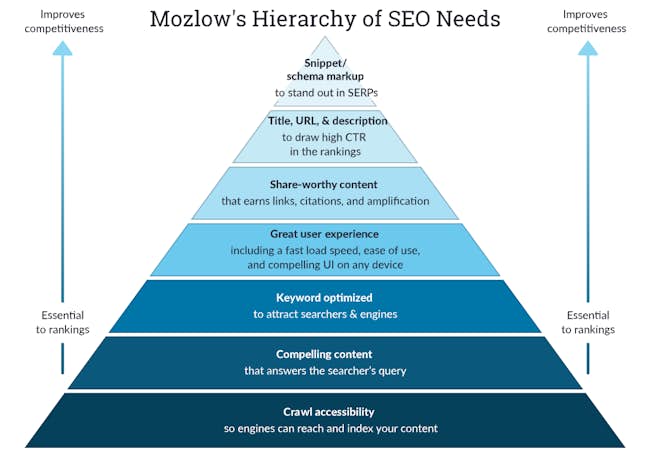
Technical SEO is the foundation of SEO. It covers everything that affects how easily search engines can access, crawl, understand, and index your website. Think of it as the infrastructure that everything else sits on. If your technical setup is broken, even excellent content will struggle to rank.
The key areas of technical SEO include:
Site speed and Core Web Vitals. Google measures page experience through a set of metrics called Core Web Vitals, which evaluate load speed, visual stability, and how quickly your page responds to user interaction. Sites improving from "Poor" to "Good" Core Web Vitals scores report 25% conversion rate increases and 35% bounce rate reductions. Speed is not just a ranking factor. It directly affects whether visitors stay on your page once they arrive.
Mobile-friendliness. Google uses mobile-first indexing, meaning it primarily evaluates the mobile version of your site for ranking purposes. A website that works beautifully on desktop but is difficult to use on a phone is penalized in rankings and loses users before they can convert.
Crawlability and indexability. Your site needs to be structured so that Google's crawlers can navigate it without hitting dead ends. This means having a clear sitemap, logical internal linking, no broken pages, and no technical barriers that accidentally block crawlers from accessing important content.
HTTPS security. Google gives a ranking preference to sites served over HTTPS. Beyond rankings, a secure site builds user trust. If your site still shows "Not Secure" in the browser bar, fixing this is a first-day priority.
Structured data (Schema markup). This is code added to your pages that explicitly tells Google what type of content they contain. Schema markup for articles, FAQs, products, local businesses, and reviews helps Google understand your content more precisely and can earn you enhanced SERP features like star ratings, FAQ dropdowns, and rich snippets.
On-page SEO covers everything you control within your individual pages to help both search engines and human readers understand what your content is about and why it deserves to rank.
Keyword research. This is the starting point for all on-page work. Keyword research means identifying the specific words and phrases your target audience uses when searching for what you offer. Good keyword research reveals not just what people search for, but how often, how competitive those terms are, and what they are actually trying to accomplish with their search.
Search intent. Every search query has an intent behind it. Someone searching "what is SEO" wants an explanation. Someone searching "SEO agency for small business" wants to hire someone. Someone searching "SEO pricing" is comparing options before making a decision. Matching your content to the intent behind a keyword is now more important than matching exact keywords. Google's algorithm has become highly sophisticated at detecting when content genuinely serves the user's purpose and when it is just trying to rank.
Title tags and meta descriptions. The title tag is the clickable headline that appears in search results. It should include your target keyword and accurately describe the page content within 50 to 60 characters. The meta description is the short summary that appears beneath the title. It doesn't directly affect rankings, but a well-written meta description improves click-through rates, which does.
Header structure. Using H1, H2, and H3 tags to organize your content serves two purposes. It makes your page easier for human readers to scan, and it signals content hierarchy to search engines. Your H1 should appear once per page and include your primary keyword. H2s and H3s organize supporting sections.
Content quality and depth. High-quality content is the cornerstone of successful SEO. Google prioritizes informative, engaging, and trustworthy content that genuinely addresses users' search queries. Thin content with no real depth, or content that exists only to match a keyword rather than to help a reader, consistently performs poorly in modern search.
Internal linking. Linking from one page on your site to another helps both users and crawlers navigate your content, distributes authority across your pages, and signals to Google the relationship between different pieces of content on your domain.
Off-page SEO refers to everything that happens outside your own website that influences how search engines perceive your authority and credibility. The most important off-page signal is backlinks.
A backlink is a link from another website pointing to yours. Google treats backlinks like votes of confidence: when a respected, authoritative website links to your content, it signals that your content is worth referencing. Not all backlinks are equal. A link from a major industry publication carries far more weight than a link from a random directory. The quality, relevance, and authority of the sites linking to you matters much more than the raw number of links.
How to earn backlinks legitimately:
Publishing original research, data studies, or comprehensive guides gives other writers and publishers material worth citing. A well-researched industry study with original statistics can earn dozens of natural backlinks over time.
Guest posting on authoritative publications in your industry places your content and your link in front of a relevant audience while building your external authority profile.
Digital PR, meaning getting your business mentioned in news articles, expert roundups, or industry reports, generates high-authority links from publications that are difficult to earn any other way.
Creating tools, templates, or resources that others in your industry find genuinely useful attracts natural links from people recommending those resources to their own audiences.
Brand mentions and local citations. Beyond backlinks, your brand's presence across the web matters. Consistent business listings across directories like Google Business Profile, Yelp, and industry-specific platforms reinforce your entity signals and support local SEO rankings. Unlinked brand mentions on reputable sites also contribute positively to how Google perceives your authority.
E-E-A-T stands for Experience, Expertise, Authoritativeness, and Trustworthiness. It is the framework Google uses to evaluate the overall quality of a website and its content, and it has become one of the most important concepts in modern SEO.
Google rolled out 12 confirmed algorithm updates between 2024 and 2025, with E-E-A-T signals now determining who ranks for competitive queries.
Experience is the newest addition and the one most often overlooked. It asks whether the content creator has real, first-hand experience with the subject they are writing about. A travel guide written by someone who has actually visited the destination demonstrates experience. A medical article written by a practicing physician demonstrates experience. Content that reads as though it was assembled from research alone, without genuine personal or professional engagement with the subject, scores poorly on this dimension.
Expertise refers to the depth of knowledge and skill demonstrated in the content. Is the information accurate? Is it detailed enough to be genuinely useful? Does it reflect the understanding of someone who truly knows this subject, or does it skim the surface?
Authoritativeness is about your reputation within your industry or topic area. Are other recognized authorities citing you, linking to you, or referencing your work? Do you have credentials, recognition, or a track record that establishes you as a notable source in your field?
Trustworthiness is the overarching dimension. Does your website operate transparently? Is there a clear author behind your content? Are your business details, policies, and contact information visible? Is the information on your pages accurate and up to date?
For a business website, building E-E-A-T in practice means publishing content under named, credentialed authors. It means sharing real case studies and results. It means keeping your information current, citing credible sources, displaying your business address and contact details, and earning recognition from respected sources in your industry.
Artificial intelligence is already used to optimize many areas of SEO. From using tools to help with keyword research and content generation to AI overviews in search engines
Developments to monitor in AI and SEO are:
SEO is not a fast channel. Most businesses begin to see meaningful results between three and six months after starting a consistent optimization effort, with more significant growth compounding over twelve months and beyond. The timeline depends on your starting point, how competitive your market is, and how consistently you publish and optimize.
The delay exists because Google needs time to crawl new content, evaluate your pages against competing results, and assess the trust signals your domain is accumulating. Once that trust is established though, SEO delivers compounding returns that paid advertising does not. A well-ranking page continues to attract organic traffic month after month without ongoing spend.
While it can feel like a time-consuming task to set objectives, measuring them can help you make progress with your SEO in the long term.
So what metrics should you measure to track performance?
Keywords - These are the terms people type into search engines or social media sites. Tracking which keywords your site ranks for and the performance of each will help you understand the visibility of content to your target audience. This metric is for Top of the Funnel (TOFU).
Organic traffic - These are the visitors who arrive at your website through organic search results. An increase in organic traffic is a good indicator that your SEO strategies are working. This is a TOFU metric.
Search Engine Results Page (SERP) results - SERP rankings show where your page appears for specific queries and the higher you are, the better your visibility. This is a TOFU metric.
Time spent on page - This shows how long people are spending on your pages. If people are spending a long time on a page, it suggests they are finding the content valuable and informative. This is a Middle of the Funnel (MOFU) metric.
Engagement rate - This measures how people are engaging with your site and includes likes, shares, time on site, or comments. A high engagement rate is a good indication that your content or message is working. This is a MOFU metric.
Click-through rate - This metric shows how many people are clicking through on a page or site after seeing a search result. The higher the CTR, the better! This is a TOFU metric.
Brand awareness - This measures recognition and recall of your brand name or products/services which can lead to brand loyalty and brand recognition. This is a TOFU metric.
Leads and revenue - By linking leads and revenue to SEO you can see how effective your activities and efforts are and look to replicate those that perform. This a Bottom of the Funnel (BOFU) metric.
Domain authority - This metric predicts how likely a website is to rank in search results so improving domain authority correlates with stronger SEO performance. This is a TOFU metric
If you are beginning from scratch, the most practical sequence is this:
Set up Google Search Console and Google Analytics 4 first. These free tools give you visibility into how Google sees your site, which queries are driving impressions and clicks, and how users behave once they arrive. They are the measurement foundation for everything else.
Conduct a basic technical audit. Check your site speed using Google's PageSpeed Insights tool, confirm your site is mobile-friendly, verify it is served over HTTPS, and make sure Google can access your important pages.
Do keyword research for your core pages. Identify two to three keywords for each key page of your site, focused on the specific terms your customers actually use when looking for what you offer.
Create or improve your content. For each page, make sure the content genuinely and thoroughly addresses the intent behind the keyword. Add your target keyword to the title tag, the H1, and naturally throughout the content.
Build your first backlinks. Reach out to industry directories, ask satisfied clients for mentions, and start thinking about what original content your business could publish that others in your industry would find worth referencing.
Then repeat, measure, and refine. SEO is not a one-time project. It is a continuous discipline that rewards consistency over time.
Now that you know what SEO is and how to use it, would you like a career in the area?
If the answer is yes, then you’re in luck. Not only is it a skill that’s in high demand by companies across industries, but you can also make a healthy living from it.
In 2025, 91% of marketers reported that SEO positively impacted website performance and marketing goals. Increasing brand awareness through SEO ranked as a top priority across all roles.
Companies rely on organic traffic to increase online visibility and when it works, they enjoy the rewards of SEO as a low-cost strategy.
There are a number of skills you need to succeed in the area of SEO.
Keyword research - Understanding how to find and use the right keywords through keyword research can help your content rank higher on search engines and social media, drive targeted and high intent traffic, and increase conversions.
Link building strategy - Knowing how to use internal and external links to build authority and show your depth of knowledge can help content to rank higher and build brand awareness.
Content optimization - Understand how to create relevant and informative content that your audience wants and needs by developing content pillars. You should also update and optmize content to ensure new content gets attention and top-performing content keeps bringing in traffic.
Data analysis - SEO relies on data. This means that you need to be able to analyze data to get insights into customer behavior and understand the reasons behind increases or drops in site traffic or conversions related to SEO.
Content marketing or copywriting - Being able to write good copy is a real bonus as an SEO specialist. Luckily there are now lots of AI tools you can use for copywriting to generate ideas, create outlines, provide recommendations for optimization or proofread.
Technical SEO - Get to grips with the technical aspects of SEO to improve a website's visibility and performance. Elements to consider are page speed, structured data, broken links and mobile optimization.
As well as these hard, or technical skills, you also need to consider your ‘soft skills’, such as critical thinking, communication, and teamwork.
There are many great resources and tools out there to help with your SEO activities. Some have free plans and others are paid, so it’s about finding what’s best for you. The tools mentioned here aren’t all that is there. You can also search the internet for more other very useful SEO tools.
Algorithm. The system Google uses to evaluate and rank web pages. It considers hundreds of signals and is updated regularly.
Backlink. A link from another website pointing to yours. A primary signal of authority and trust in off-page SEO.
Crawling. The process by which Google's automated bots visit web pages, follow links, and collect information about content across the internet.
Core Web Vitals. A set of Google metrics measuring page experience: Largest Contentful Paint (load speed), Interaction to Next Paint (responsiveness), and Cumulative Layout Shift (visual stability).
Domain Authority. A score developed by Moz (and similar metrics from other tools) that estimates how likely a domain is to rank well in search results, based primarily on its backlink profile.
E-E-A-T. Experience, Expertise, Authoritativeness, Trustworthiness. Google's quality framework for evaluating content and the credibility of its source.
Featured Snippet. A highlighted answer box that appears at the top of Google search results, above the ranked links, displaying a direct answer to a query extracted from a web page.
Google Business Profile. A free Google tool for businesses to manage how they appear in Google Search and Maps. Essential for local SEO.
Google Search Console. A free Google tool that shows how your site performs in search: which queries trigger your pages, your click-through rates, indexing issues, and more.
Index. Google's database of all the web pages it has crawled and stored. Only indexed pages can appear in search results.
Internal Link. A link from one page of your website to another page on the same website. Helps users navigate and distributes authority across your site.
Keyword. A word or phrase that people type into a search engine. The foundation of content targeting in SEO.
Keyword Research. The process of identifying which keywords your target audience uses, how often they search for them, and how competitive they are.
Meta Description. A short summary of a page's content that appears beneath the title in search results. Does not directly affect rankings but influences click-through rates.
Organic Traffic. Visitors who arrive at your website by clicking a non-paid search result.
Page Speed. How quickly a web page loads for a user. A direct ranking factor and a major influence on user experience.
Ranking. The position of a page in search engine results for a specific query. Position 1 is the top result.
Schema Markup. Code added to a webpage that explicitly describes its content to search engines, enabling rich results and better AI comprehension.
Search Intent. The underlying goal behind a search query. The four main types are informational, navigational, commercial, and transactional.
SERP. Search Engine Results Page. The page Google displays in response to a search query.
Sitemap. A file that lists all the important pages on your website, helping Google discover and crawl them efficiently.
Title Tag. The HTML element that defines the title of a web page. Appears as the clickable headline in search results and is one of the most important on-page SEO elements.
Topical Authority. The degree to which a website is recognized as a comprehensive, trustworthy source on a specific subject area, built through depth and breadth of content on that topic.
Need help putting these fundamentals into practice for your business? Want to increase your online visibility and drive more traffic to your website?
Consider hiring an SEO at BoostSiteSEO. Our specialized SEO services will improve your website's search engine ranking, helping your business grow and reach more customers. With years of experience and proven results, we offer customized SEO strategies perfectly aligned with your business goals. Let our experts handle the heavy lifting, so you can focus on what you do best: running your business.
BoostSiteSEO offers complete SEO, AEO, and GEO services built on the principles in this guide. Start your free audit at BoostSiteSEO.com
